
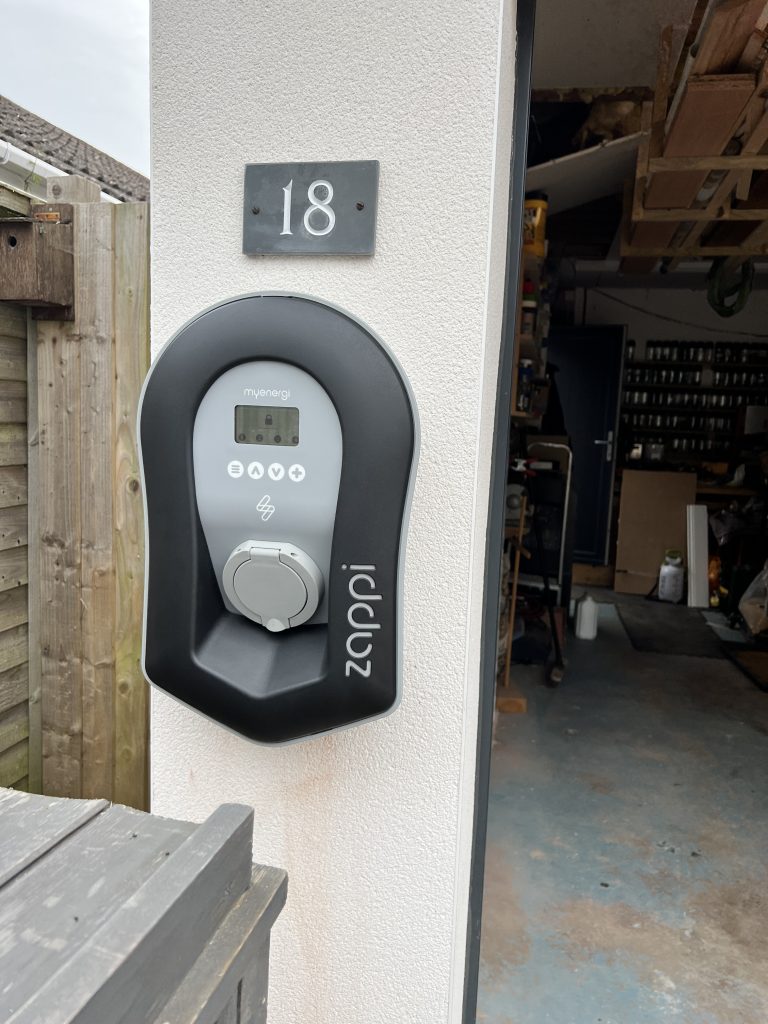
A home electric car charging point in the UK usually costs between £800 and £1,200 fitted, though the final figure depends on the charger you choose and how much wiring your property needs. This guide breaks down what you actually pay, what drives the price up or down, the grants still available in 2026, and how to keep your ongoing charging costs low.
Electric Car Charging Point Costs Explained
An electric car charging point costs around £800 to £1,200 for a standard 7kW home unit including installation, with the charger itself making up roughly £450 to £800 of that. That range is in line with the RAC’s guide to home charge point costs, which puts a typical installation at around £800 to £1,200. More complex jobs or higher-power units push the total higher, and it helps to look at the equipment cost and the fitting cost separately, because they move for different reasons.
Typical EV Charger Prices
The price of a charging point splits into two parts: the hardware and the fitting. A 7kW home charger unit typically runs from £450 to £800 depending on the brand and features, and installation adds a few hundred pounds on top. Put together, most homeowners pay somewhere near £1,000 for a straightforward install.
A home charger, a commercial charger and a public charging station are three different things. A home charger is a wallbox fixed to the side of your house for your own use. A commercial charger is a heavier-duty unit built for workplaces or car parks, often with several sockets. A charging station usually refers to a public site with rapid or fast chargers that anyone can pay to use, and the costs climb steeply as you move up that scale.
Average Installation Costs
Installation cost covers the electrician’s labour, the wiring, a dedicated circuit, and sometimes an upgrade to your consumer unit or fuse board. A typical fit takes a qualified electrician a few hours, and the labour alone might be £200 to £400 of the total.
Charging points require professional installation, and that is not just a rule for the sake of it. Wiring a dedicated circuit safely, adding the right protection, and running cable from your fuse board to the charger is skilled work that has to meet electrical regulations. Property type influences the cost too. A short cable run to a garage wall is cheap, while trenching across a driveway or upgrading an older fuse board adds to the bill — replacing a consumer unit typically runs from about £350 in a small home to £800 in a larger one, averaging around £485.
What Affects the Total Cost?
Several things move the final price: the charger brand, its power output, the connector type, warranty length, smart features, and how complicated the install is. A basic untethered 7kW unit sits at the lower end, while a smart charger with app control and a long warranty costs more.
Your home’s electrical capacity and existing wiring can push costs up. If your fuse board is old or already full, it may need upgrading before a charger can be added safely. A long distance between the board and the parking spot means more cable and labour. Getting a certified, professional installation matters here, both for safety and so your charger works reliably for years.
Choosing the Right EV Charging Point
The right charging point depends on whether you are charging at home or at work, how fast you need to charge, and your electrical supply. Getting the match right saves money both now and over the life of the charger.
Home EV Chargers
Most home chargers are 7kW units, which suit the vast majority of UK households. You will also see smart chargers, and a choice between tethered and untethered wallboxes. A tethered charger has a cable permanently attached, which is handy for everyday use. An untethered unit has just a socket, so you plug in your own cable and it keeps the wall tidier and future-proof if connector standards change.
EV chargers reduce home charging costs compared with relying on public chargers, which usually charge a premium per unit. In fact around 85% of EV charging happens at home, where the electricity is far cheaper than on the public network. Charging overnight at home on a cheap tariff is far kinder to your wallet. For most homeowners and EV owners, a 7kW smart charger hits the sweet spot of speed, cost and control.
Commercial & Workplace Charging Stations
Commercial and workplace chargers differ from home units in scale and toughness. They are built to handle heavy daily use, often carry multiple sockets, and may run at higher power. A single workplace charger commonly costs somewhere in the region of £1,000 to £1,500 per socket installed, though commercial pricing varies widely with power rating and groundworks, and larger sites cost more.
Businesses install workplace charging stations to support staff, fleet vehicles and visitors, and increasingly to meet sustainability targets. The Workplace Charging Scheme now gives up to £500 per socket across as many as 40 sockets per applicant, which takes a real bite out of a multi-bay installation. When planning a commercial setup, it is worth thinking about scalability, how many users you need to serve at once, and future-proofing so you can add sockets later without redoing the groundwork.
Charger Speed Comparison
Charging speed depends on charger power, measured in kilowatts (kW). A 7kW charger adds roughly 20 to 30 miles of range per hour depending on how efficient your car is — the Energy Saving Trust reckons about 7 miles for every 20 minutes plugged in, which comfortably tops up most cars overnight. A 22kW charger is faster but needs a three-phase electricity supply, which most homes do not have. Fast and rapid chargers, found at public stations, run far higher and can charge a car in under an hour, but they are not something you fit at home.
The catch with 22kW is the supply. Homes usually have a single-phase electricity supply, which caps you at 7kW in practice. Businesses often have three-phase power, so 22kW makes sense there. Matching the charger to your supply avoids paying for speed you cannot actually use.
Ongoing Charging Costs and Ways to Save Money
Buying the charger is only part of the picture. What you pay to charge, month after month, depends on your electricity tariff, your driving, and whether you charge smartly.
Cost to Charge an Electric Car in the UK
The cost to charge an electric car at home depends on your electricity price per kilowatt-hour (kWh) and your car’s battery size. As a rough guide, a 60kWh battery charged from near-empty at the current Ofgem price cap rate of 26.11p per kWh (1 July–30 September 2026) costs about £16 for a full charge, giving you a couple of hundred miles. The RAC puts the real-world range at £4 to £20 per full charge once tariff and battery size are taken into account.
Charging costs vary with your tariff and battery size. Electricity tariffs affect charging costs, and this is where the biggest savings hide. A dedicated EV tariff with cheap overnight rates can drop the price of that same full charge dramatically — often to a third of the standard cost or less, which is why the RAC’s range starts as low as £4. A bigger battery costs more to fill but also goes further, so the cost per mile stays broadly similar.
Smart Charging and Solar Panels
Smart chargers optimise electricity usage by charging when power is cheapest. You can set a schedule so the car charges in the small hours on an off-peak rate, rather than during expensive peak times. Smart charging schedules reduce electricity bills by shifting your biggest single load to the cheapest part of the day.
Solar panels power EV chargers too, and this is where a lot of our customers find the real value. On a bright day your panels can charge the car for next to nothing, and any surplus can be stored in a home battery for later. Pairing solar, battery storage and an EV charger turns your roof into your fuel supply, which is hard to beat on running cost.
Running Costs Over Time
Over time, home charging works out far cheaper than relying on public charging stations, where prices per unit are much higher. Against a home rate of around 26p per kWh, public rapid and ultra-rapid chargers averaged 79p per kWh on Zapmap’s price index, with slower public chargers around 54p — so charging at home on an off-peak tariff can cost a fraction of a public rapid charger, and those savings stack up fast for a daily driver.
Beyond electricity, running costs are low. Chargers need little maintenance, most carry a warranty of three years or more, and energy monitoring through an app helps you keep track of what you spend. The long-term saving, especially against petrol or diesel, is a big part of why people make the switch.
Government Grants, Installation Requirements and Safety
Grants can take a chunk off the cost, but the rules changed in recent years, so it is worth knowing exactly who qualifies now. Safe, compliant installation also protects both your home and your investment.
Grants and Financial Support
Government grants reduce installation costs, but the old scheme for homeowners with a driveway has ended. As of 2026, the EV chargepoint grant gives 75% off — up to £500 — for renters and flat owners with dedicated off-street parking. There is also a separate grant of up to £500 for households that rely on on-street parking and fit a cross-pavement solution. Homeowners who own a house with their own driveway are no longer eligible on their own.
Businesses and landlords have their own support. The Workplace Charging Scheme offers up to £500 per socket for eligible organisations, and there is a separate landlord grant of up to £500 per socket for rental and social housing properties. If you are a renter, a flat owner, a landlord or a business, it is well worth checking which scheme fits before you book an install. (Note: all four grants rose from £350 to £500 per socket on 1 April 2026.)
Installation Process
Electricians install EV charging points by fitting a dedicated circuit from your consumer unit to the charger, adding the correct protective devices, and testing everything before handover. A standard home install is usually finished in half a day.
The timeline is short, but some homes need electrical upgrades first, such as a new consumer unit or an isolator switch. Dedicated circuits improve charging safety by keeping the high, sustained load of car charging separate from the rest of your home’s wiring. That is a core reason the work has to be done by a qualified professional rather than a general handyman.
Safety and Future-Proofing
Safety comes from certified equipment, weatherproof construction and secure operation. An outdoor charger has to cope with British weather, so a properly rated, well-installed unit is a must. Certified installation means the charger meets current wiring standards and is safe to use in all conditions.
Future-proofing is about picking smart features you will still want in five years: Wi-Fi connectivity, app control, load balancing so the charger eases off when your home draws a lot of power, and automation that ties in with cheap tariffs or solar. A smart charger with a long warranty costs a little more now but saves hassle down the line.
Is an Electric Car Charging Point Worth the Cost?
For most drivers, a home charging point pays for itself through cheaper, more convenient charging within a couple of years. The value shifts a bit depending on whether you are a homeowner, a business or a fleet operator, but the core case is strong across the board.
Benefits for Homeowners
Home chargers increase convenience in a way public charging cannot match. Your car charges overnight on your driveway and is full every morning, with no queuing or paying premium public rates. That alone changes how living with an electric car feels.
Charging points increase property value as well, since a growing number of buyers see a home charger as a must-have — unsurprising when battery-electric cars now take more than a quarter of new-car registrations and the UK has passed two million on the road. Set the modest upfront investment against years of cheaper charging and the higher convenience, and for most households the sums add up quickly, especially when paired with solar or an off-peak tariff.
Benefits for Businesses
Commercial chargers support multiple users, from staff and fleet vehicles to visiting customers. A workplace charging setup helps a business attract and keep talent, run an electric fleet cheaply, and show customers it takes sustainability seriously.
For fleet managers, workplaces and customer car parks, the return on investment comes through lower fuel costs, grant support, and stronger green credentials. As more of the country moves to electric, having charging in place is fast becoming an expectation rather than a perk.
How to Choose the Best Charger
Choosing the best charger comes down to power output, compatibility with your car, connector type and smart features. Nearly all modern electric cars use a Type 2 connector, so a 7kW Type 2 smart charger suits most homes. Check the unit works with your vehicle and your electricity supply before you commit.
Match the charger to your budget, your property and your charging habits. If you drive a lot and can charge overnight, a smart 7kW unit on an off-peak tariff is hard to beat. The key factors in total ownership cost are the install price, the tariff you charge on, and whether you can lean on solar to bring the running cost down further.
If you already have solar or are thinking about it, an EV charger fits neatly into the same system. Our online system builder lets you add a charger to a solar and battery setup and see how it fits your home, with no obligation. Our team across the West Midlands and Warwickshire is happy to talk through the options whenever you are ready.